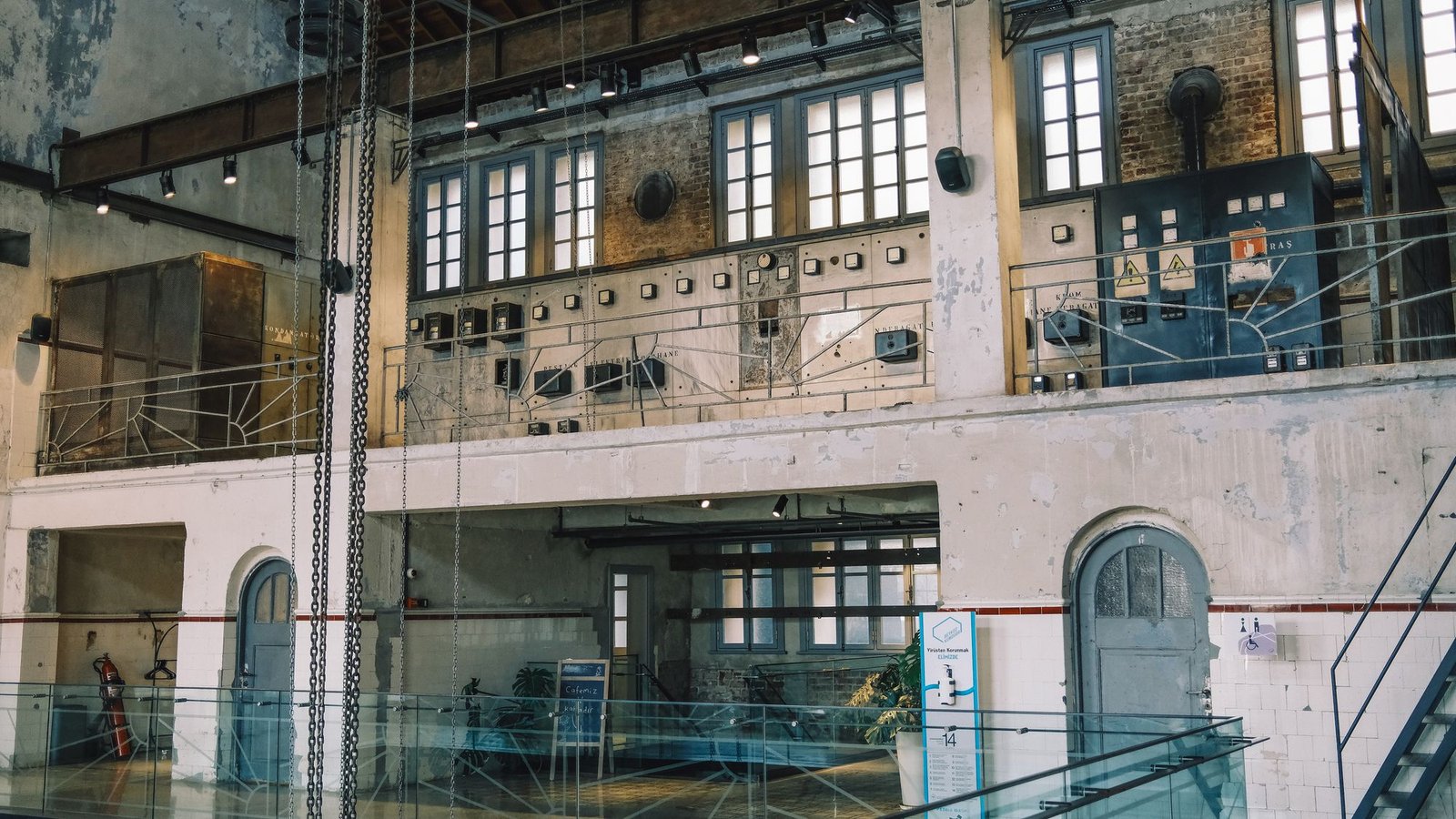
The 1908 foundry in Rotterdam was structurally excellent and thermally hopeless: 9,600 square metres of single-skin brick, cast iron and boarded-over north lights. The instinct — and the first three feasibility studies we were shown — was to insulate the envelope and heat the whole thing.
That would have cost more than the building was worth, buried the frame behind linings, and produced a warm shed that nobody needed. What the tenants actually needed was about 2,400 square metres of warm space. The other 7,200 could be exactly what it already was: dry, sheltered, unheated and enormous.
So we insulated five timber boxes and stood them free inside the hall, on their own pads, touching nothing. The hall itself is now a covered street, open to the city, unheated eleven months a year and busy in all of them.
The cheapest carbon is the carbon already in the ground.
This is the single most useful move in retrofit and it is under-used because it fails a naive brief. If the brief says 9,600 square metres at 21°C, you cannot do it. If the brief is rewritten to say what actually needs to be warm and when, most industrial buildings become viable overnight.
The second discipline is legibility. Everything we added is bolted rather than welded, and painted a deliberate off-red. In fifty years someone should be able to read the building in layers and know instantly which century each one came from. Matching the original is a kind of forgery, and it makes future repair harder, not easier.
Third: catalogue before you demolish. Everything removed from the foundry was recorded and most of it was reused on site. The travelling crane still runs; it carries exhibition rigging now instead of a ladle.
The carbon arithmetic is not close. Retaining the frame and envelope avoided roughly 4,100 tonnes of CO₂e against a new building of the same area — more than the operational emissions of the finished project for its first four decades. That number is the argument, and it should be in the first paragraph of every feasibility study, not the appendix.
None of this is an argument for keeping everything. Some buildings are genuinely finished, and pretending otherwise wastes money that could build something good. But the default has to be reversed: demolition should be the case that has to be proved.