
12 Reasons Your Website Isn’t Getting Leads
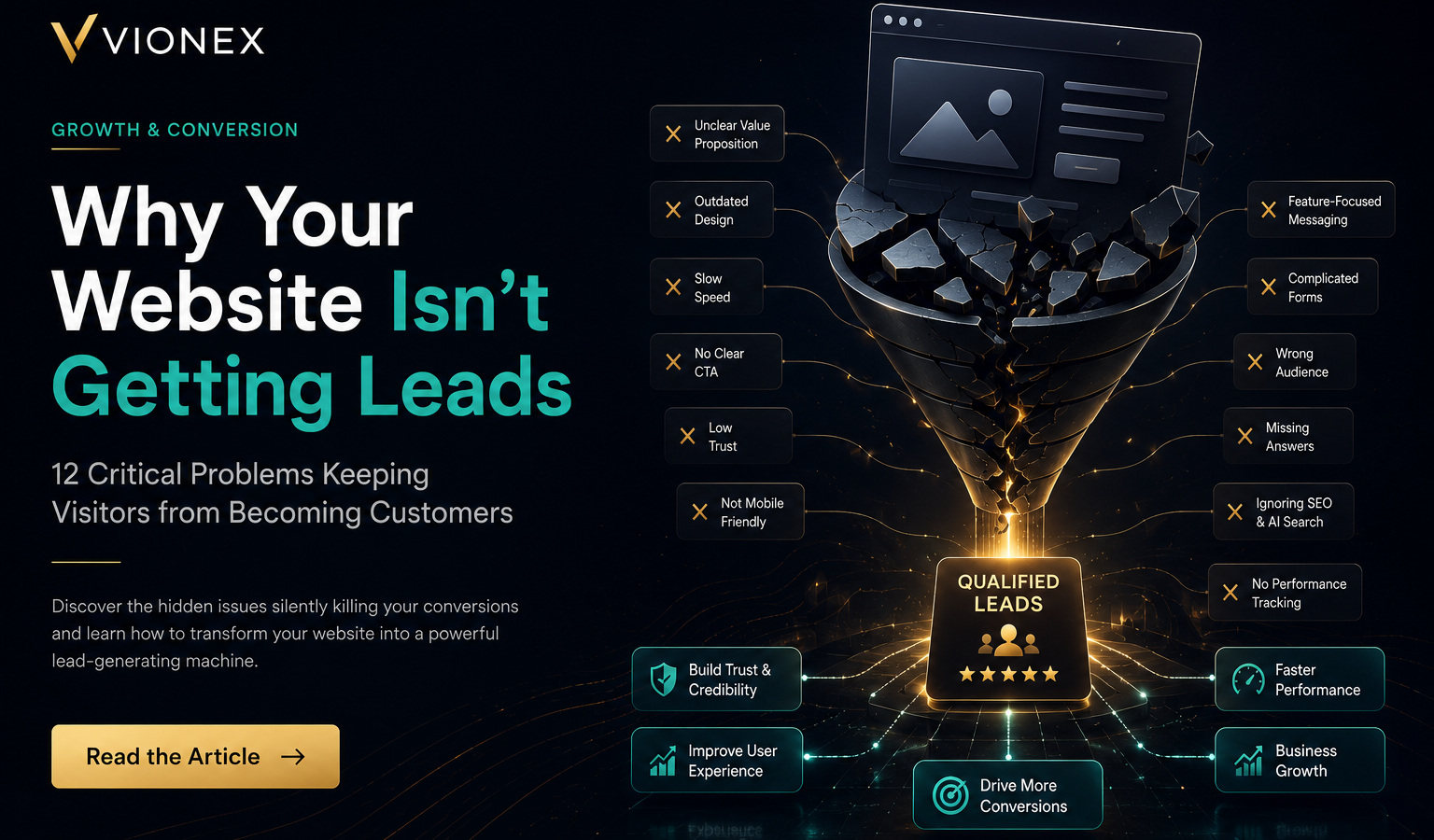
Your website should be more than a digital business card—it should be your most effective salesperson. A professionally designed website works around the clock, attracting potential customers, building trust, and converting visitors into qualified leads. Yet many businesses invest thousands in a website only to discover that inquiries, phone calls, and sales never arrive.
If your website is getting traffic but not generating leads, the issue is rarely the number of visitors. More often, the problem lies in how effectively your website communicates value, builds trust, and guides users toward taking action. Industry experts consistently identify conversion optimization, clear messaging, user experience, and trust-building as the biggest factors separating high-performing websites from those that fail to generate business.
This guide explains the most common reasons websites fail to convert visitors and how modern businesses can solve these issues.
1. Your Value Proposition Isn’t Clear
Visitors decide within seconds whether your business is relevant to them. If they cannot immediately understand:
- What you do
- Who you help
- Why you’re different
- What results you deliver
they will leave without exploring further.
Many websites focus on the company instead of the customer’s problem. Instead of explaining services in technical language, successful websites clearly communicate the outcome customers can expect.
For example:
❌ “We build responsive websites.”
✅ “We design high-converting websites that help businesses generate more leads and increase revenue.”
The second statement immediately tells visitors the benefit.
2. Your Website Looks Outdated
People judge businesses by their websites.
An outdated design creates doubts about professionalism, reliability, and quality. Even if your services are excellent, visitors often assume your business is outdated as well.
Modern websites should include:
- Clean layouts
- Professional typography
- High-quality imagery
- Consistent branding
- Mobile responsiveness
- Modern UI elements
- Fast interactions
First impressions significantly influence trust.
3. Slow Loading Speed Is Driving Visitors Away
Speed directly affects user experience and conversions.
A slow website frustrates users before they even read your content.
Common causes include:
- Large unoptimized images
- Heavy animations
- Too many plugins
- Poor hosting
- Excessive JavaScript
- Unused CSS
Improving loading speed often reduces bounce rates while improving both search rankings and lead generation.
4. There Is No Clear Call-to-Action
Many websites explain their services but never tell visitors what to do next.
Every important page should encourage users to take a specific action.
Examples include:
- Book a Free Consultation
- Get a Free Quote
- Schedule a Discovery Call
- Request a Website Audit
- Contact Our Team
Calls-to-action should be visible throughout the page—not just in the footer.
5. Your Website Doesn’t Build Trust
Visitors hesitate to contact businesses they don’t trust.
Trust can be established through:
- Client testimonials
- Case studies
- Google reviews
- Certifications
- Awards
- Portfolio examples
- Real team photos
- Client logos
Social proof reduces uncertainty and reassures visitors that others have achieved success with your business.
6. Your Website Isn’t Mobile Friendly
Most users now browse on smartphones.
If your website requires zooming, has tiny buttons, slow loading, or confusing navigation, visitors will leave before contacting you.
A responsive website should provide:
- Easy navigation
- Readable text
- Touch-friendly buttons
- Fast mobile performance
- Simple contact forms
A mobile-first approach is now essential rather than optional.
7. Your Content Focuses on Features Instead of Benefits
Businesses often describe what they do instead of explaining why it matters.
Instead of saying:
- Custom Development
- Responsive Design
- SEO Optimization
Explain the results:
- Generate more qualified leads
- Improve search visibility
- Increase customer trust
- Convert more visitors into paying customers
- Grow your online revenue
Customers buy outcomes—not features.
8. Your Contact Process Is Too Complicated
Every additional step reduces conversions.
Common mistakes include:
- Long contact forms
- Mandatory account creation
- Too many required fields
- Confusing navigation
- Hidden contact information
A simple contact form with only essential fields often converts significantly better.
9. You’re Attracting the Wrong Audience
Sometimes the website isn’t the problem.
Poor SEO targeting, ineffective advertising, or generic messaging may attract visitors who have no intention of becoming customers.
Successful websites align:
- Keywords
- Content
- Landing pages
- Services
- Customer intent
When the right audience lands on the right page, conversions improve naturally.
10. Your Website Doesn’t Answer Customer Questions
Potential clients always have questions:
- How much does it cost?
- How long does it take?
- Why choose you?
- What industries do you serve?
- What’s included?
The more questions your website answers, the more confident visitors become.
Helpful content positions your business as an authority while reducing hesitation.
11. You’re Ignoring Modern SEO and AI Search
Search behavior is changing rapidly.
Today, websites should be optimized not only for traditional search engines but also for AI-powered search experiences and answer engines. Well-structured content, clear headings, FAQ sections, and authoritative information improve visibility across modern search platforms.
Businesses that adapt early gain a competitive advantage.
12. You Never Measure Performance
Many businesses launch a website and never analyze its performance.
Without analytics, it’s impossible to know:
- Which pages generate leads
- Where visitors leave
- Which buttons get clicked
- Which traffic sources convert best
- Which forms perform poorly
Continuous improvement is what transforms an average website into a powerful sales engine.
How Vionex Builds Websites That Generate Leads
At Vionex, we believe a website should be a business asset—not just an online brochure.
Our web design and development process focuses on measurable business growth through:
- Strategic user experience (UX)
- Modern, premium interface design
- High-speed performance optimization
- Mobile-first development
- Technical SEO implementation
- Conversion-focused page layouts
- Clear calls-to-action
- Trust-building design elements
- Scalable development architecture
- Ongoing optimization and support
Every website we create is designed with one objective: helping businesses attract more visitors, build credibility, and convert traffic into qualified leads.
Final Thoughts
A beautiful website alone doesn’t generate business.
Lead generation requires the right combination of strategy, design, psychology, speed, trust, content, and technical optimization. Businesses that continuously improve these areas consistently outperform competitors with outdated or poorly optimized websites.
If your website isn’t delivering inquiries or sales, don’t assume you need more traffic. In many cases, improving the user experience and conversion strategy can unlock significantly better results without increasing your marketing budget. As many recent conversion-focused web design analyses note, the biggest gains often come from fixing clarity, trust, and conversion flow rather than simply driving more visitors.
Join the conversation