
Shopify vs WooCommerce: Which Platform Is Best in 2026?
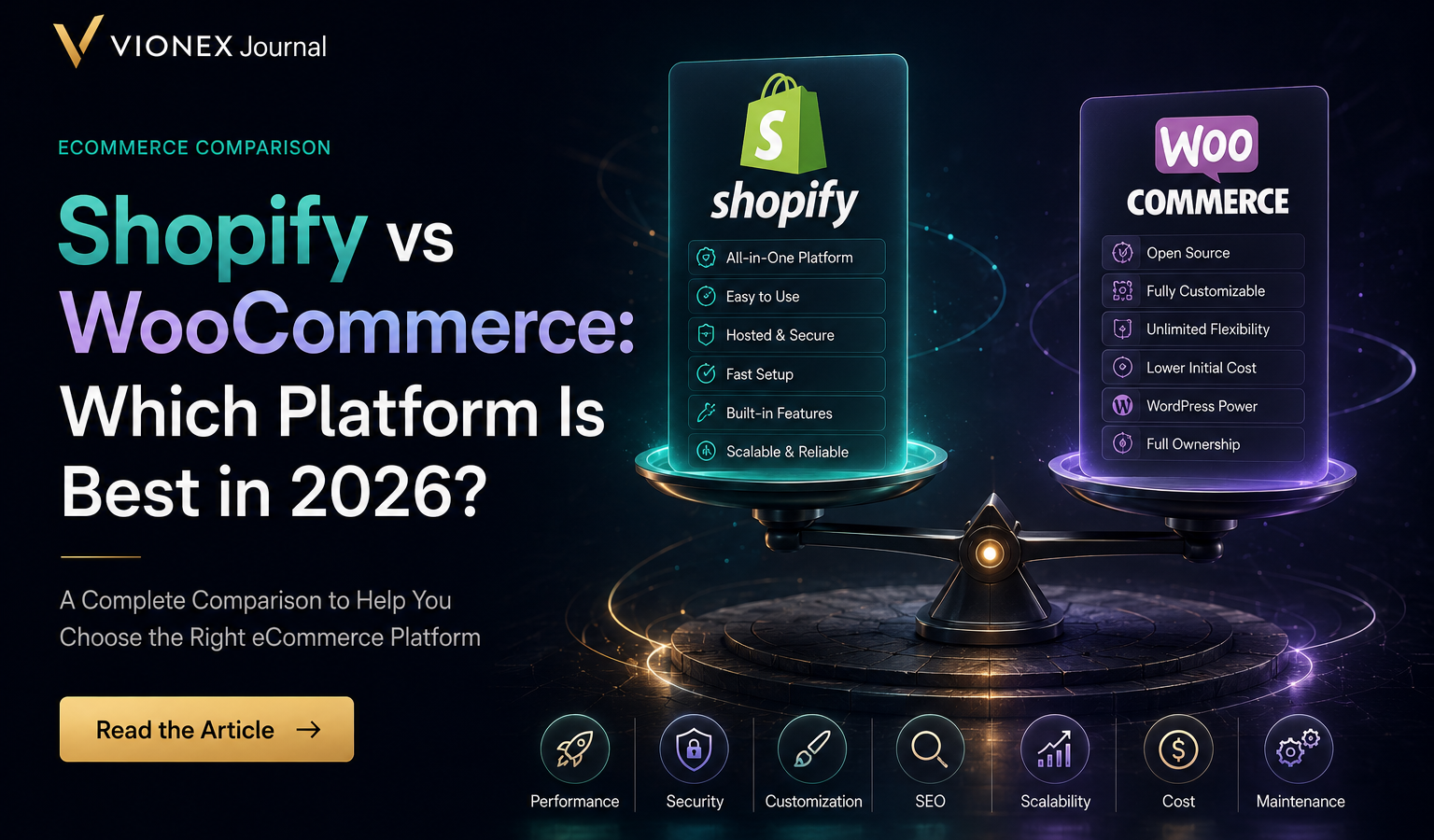
Choosing the right eCommerce platform is one of the most important decisions when starting or scaling an online business. The platform you choose will influence your website’s performance, security, scalability, customer experience, maintenance costs, and long-term growth.
Among all available eCommerce platforms, Shopify and WooCommerce remain the two most popular choices. Both power millions of online stores worldwide, but they are built with different philosophies. Shopify is a fully hosted, all-in-one commerce platform designed for simplicity, while WooCommerce is an open-source WordPress plugin that offers complete flexibility and ownership.
At Vionex, we’ve worked with businesses of different sizes and industries, helping them select the platform that best aligns with their goals. This guide compares Shopify and WooCommerce across every major aspect to help you make an informed decision.
What Is Shopify?
Shopify is a cloud-based eCommerce platform that allows businesses to launch, manage, and scale an online store without worrying about hosting, server management, software updates, or security.
Everything needed to operate an online store—including hosting, SSL certificates, inventory management, payment processing, and performance optimization—is included within one platform.
This makes Shopify an excellent choice for businesses that want to focus on selling products instead of managing technical infrastructure. Shopify continues to position itself as a commerce-focused platform with managed hosting, built-in security, frequent feature updates, and a large ecosystem of apps and integrations.
What Is WooCommerce?
WooCommerce is a free, open-source eCommerce plugin built specifically for WordPress.
Unlike Shopify, WooCommerce is self-hosted, meaning you are responsible for choosing your hosting provider, installing WordPress, managing updates, securing your website, and maintaining plugins.
The biggest advantage is flexibility. Nearly every aspect of your online store can be customized, making WooCommerce ideal for businesses requiring unique functionality or deep integration with a content-heavy WordPress website.
Shopify vs WooCommerce: Feature Comparison
1. Ease of Setup
Shopify
Shopify is designed for beginners and entrepreneurs.
After creating an account, you can:
- Choose a theme
- Add products
- Configure payments
- Launch your store
Most businesses can be online within a few hours.
WooCommerce
WooCommerce requires several setup steps:
- Purchase hosting
- Register a domain
- Install WordPress
- Install WooCommerce
- Configure plugins
- Secure the website
- Optimize performance
Although setup takes longer, it offers greater control over your website.
Winner: Shopify
2. Design and Customization
Shopify
Shopify offers professionally designed themes that are mobile responsive and optimized for conversions.
Customization is possible through Shopify’s theme editor and Liquid templating language, although some advanced changes may require development expertise.
WooCommerce
WooCommerce provides virtually unlimited design freedom.
Since it runs on WordPress, you can customize:
- Layouts
- Product pages
- Checkout flow
- Functionality
- User experience
- Custom integrations
For businesses with unique requirements, WooCommerce provides unmatched flexibility.
Winner: WooCommerce
3. Performance
Website speed directly impacts SEO, user experience, and conversions.
Shopify
Shopify manages:
- Global hosting
- CDN
- Performance optimization
- Server maintenance
Store owners rarely need to optimize technical infrastructure.
WooCommerce
Performance depends on:
- Hosting quality
- Plugin optimization
- Image compression
- Caching
- Database maintenance
With premium hosting and proper optimization, WooCommerce can perform exceptionally well, but achieving that performance requires more hands-on management.
Winner: Shopify
4. Security
Security is critical for every online store.
Shopify
Shopify includes:
- SSL certificates
- PCI compliance
- Automatic updates
- Fraud protection features
- Security monitoring
Everything is handled automatically.
WooCommerce
WooCommerce security depends on:
- Hosting provider
- Security plugins
- Backup solutions
- WordPress updates
- Plugin maintenance
Store owners are responsible for keeping everything secure.
Winner: Shopify
5. SEO
Search engine optimization is essential for attracting organic traffic.
Shopify
Shopify provides:
- SEO-friendly URLs
- Meta titles
- Meta descriptions
- XML sitemaps
- Structured data
- Fast loading pages
WooCommerce
WooCommerce benefits from the full WordPress ecosystem.
Using SEO plugins such as Yoast SEO or Rank Math, businesses gain extensive control over technical SEO, content optimization, schema, and site structure.
Businesses that rely heavily on content marketing often find WooCommerce especially powerful because of WordPress’s publishing capabilities.
Winner: WooCommerce (for advanced SEO flexibility)
6. Scalability
As businesses grow, scalability becomes increasingly important.
Shopify
Shopify scales effortlessly.
Whether selling 20 products or 200,000 products, Shopify manages:
- Infrastructure
- Traffic spikes
- Performance
- Security
WooCommerce
WooCommerce can also scale effectively but often requires:
- Better hosting
- Database optimization
- CDN configuration
- Performance tuning
Scaling WooCommerce usually involves additional technical management.
Winner: Shopify
7. Cost
Many businesses assume WooCommerce is free.
While the plugin itself is free, real-world costs often include:
- Hosting
- Domain registration
- Premium themes
- Premium plugins
- Developer assistance
- Security software
- Backup services
Shopify charges a predictable monthly subscription that includes hosting and many core services. Depending on your requirements, either platform may be more economical over time. Shopify highlights lower operational overhead in its own comparison, while WooCommerce can be cost-effective for businesses with technical expertise and modest infrastructure needs.
8. Maintenance
Shopify
Maintenance is minimal.
Shopify automatically handles:
- Updates
- Security patches
- Hosting
- Server performance
- Backups for platform infrastructure
WooCommerce
Regular maintenance includes:
- Updating WordPress
- Updating plugins
- Updating themes
- Monitoring security
- Creating backups
- Performance optimization
Businesses without technical experience may find ongoing maintenance challenging.
Winner: Shopify
Which Platform Is Better for Different Businesses?
Choose Shopify If You:
- Want to launch quickly
- Prefer an all-in-one solution
- Don’t want to manage servers
- Need excellent security
- Plan to scale rapidly
- Have limited technical knowledge
Choose WooCommerce If You:
- Already use WordPress
- Need complete customization
- Want full ownership of your website
- Publish extensive blog content
- Have development resources
- Require custom integrations
How Vionex Helps You Choose the Right Platform
At Vionex, we understand that every business has different goals, budgets, and technical requirements.
We help clients:
- Choose the right eCommerce platform
- Design premium user experiences
- Develop high-performance online stores
- Optimize websites for SEO
- Improve conversion rates
- Integrate secure payment gateways
- Build scalable solutions for long-term growth
Whether you’re launching your first online store or migrating from another platform, our team creates websites that are visually impressive, fast, secure, and designed to generate sales.
Final Verdict
Both Shopify and WooCommerce are outstanding eCommerce platforms, but they serve different audiences.
Shopify is ideal for businesses seeking simplicity, reliability, predictable maintenance, and rapid growth. WooCommerce is best for organizations that need maximum flexibility, complete ownership, and deep customization.
There is no universally “better” platform. The best choice depends on your business objectives, technical expertise, available resources, and long-term strategy.
If you’re unsure which platform is right for your business, the experienced team at Vionex can help you evaluate your requirements and build an eCommerce solution that supports sustainable growth for years to come.
Join the conversation